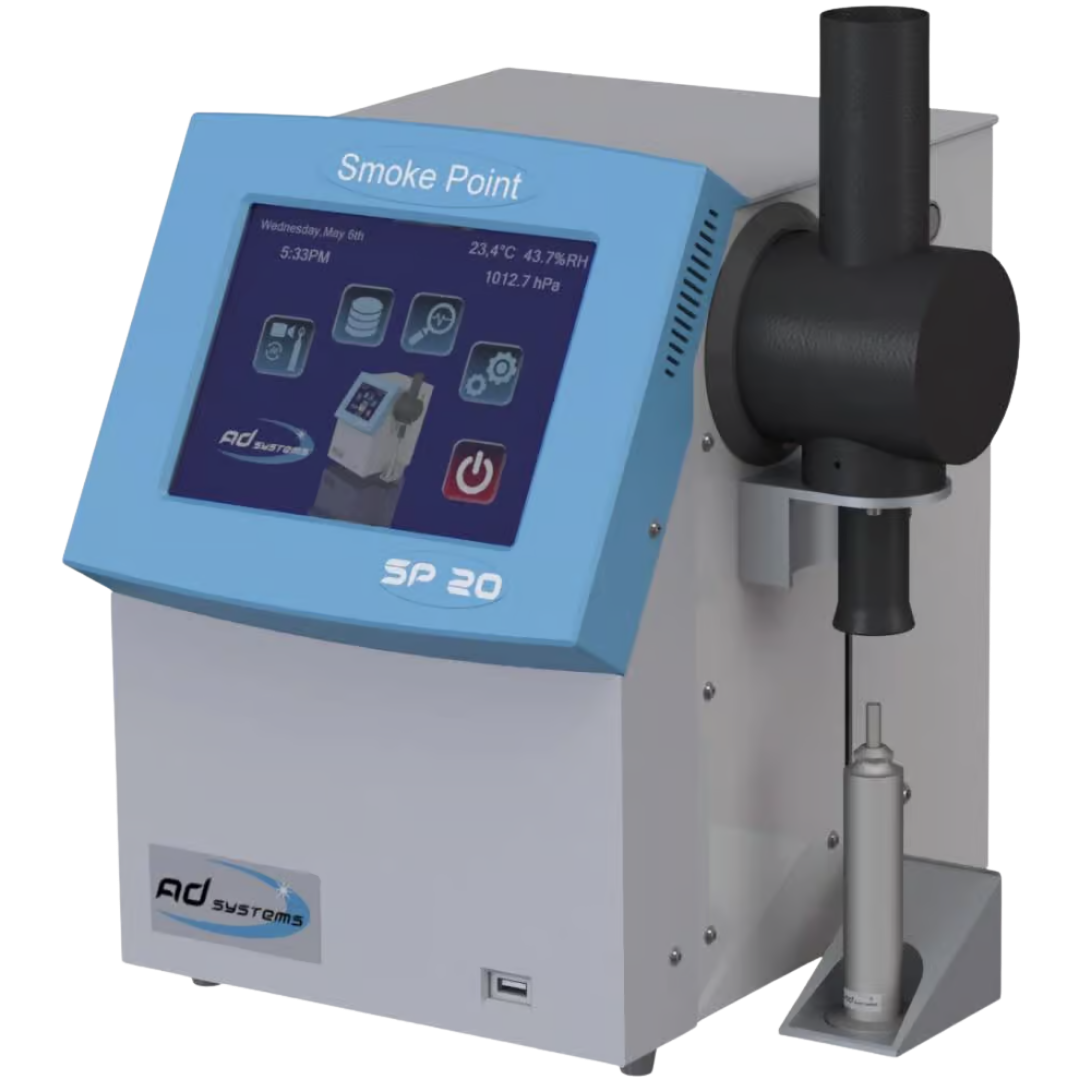
AD Systems SP20 — Automated Smoke Point
Smoke point of kerosene and aviation turbine fuel, video camera-measured to referee-grade precision. Atmospheric compensation built in.
Smoke Point Testing Has Always Depended on a Trained Eye — the SP20 Removes That Variable
Manual smoke point testing requires a highly skilled technician who can visually judge the exact moment a flame reaches the shape defined in the test method — and that judgment varies from one operator to the next. The manual test is also slow, with a full calibration procedure across seven mixes before a sample can even be run.
The SP20 replaces the visual call with a video camera and actuator system that adjusts flame size automatically and records the height the instant the flame matches the method’s defined shape. Embedded temperature, humidity, and pressure sensors apply an atmospheric conditions compensation, so the SP20 is ready for a direct sample measurement on power-up — cutting roughly two hours of calibration labor from the process.
What the AD Systems SP20 Delivers in Your Lab
Video Camera-Based Flame Height Detection
A patented camera-and-actuator system adjusts the flame and detects the instant it reaches the shape defined in the test method, recording the height automatically.
Embedded Atmospheric Compensation
Onboard temperature, humidity, and pressure sensors apply a patent-pending compensation, so only one calibration set is needed regardless of ambient conditions.
Referee-Grade Precision
The SP20's automation has improved test precision enough to become the referee instrument in ASTM D1322 and IP 598, eliminating operator-to-operator variability in the visual rating.
Fully Automated Test Sequence
Ignition, the five-minute stabilization period, and three flame-height determinations all run without operator involvement once the candle is loaded.
Touchscreen Interface, Simple Operation
8″ full-color touchscreen for sample entry and results review — no specialized training required to operate.
Built-In Data Storage & LIMS Connectivity
Results are saved to an onboard database and can be printed, sent to LIMS, or copied to USB.
Supported Test Standards
Standard Test Method for Smoke Point of Kerosene and Aviation Turbine Fuel.
The primary US standard for evaluating the smoke-producing tendency of these fuels in a diffusion flame. The SP20 is recognized as the referee instrument for this method.
The international equivalent referee method
to ASTM D1322, used in ISO 17025 accredited labs and international aviation fuel quality programs.
ALSO SUPPORTED
Specifications — AD Systems SP20
Who Uses the SP20
Aviation Fuel QC Labs
Jet fuel and turbine fuel smoke point testing for release per ASTM D1322 and D1655.
Kerosene Producers & Refiners
Smoke point characterization as part of finished-product quality control programs.
ISO 17025 Accredited Labs
Third-party fuel testing labs providing referee-grade ASTM D1322 and IP 598 results with full traceability.
Military & Defense Fuel Testing Labs
Smoke point testing to DEF STAN 91-091 for defense-specification aviation fuels.
Independent Testing Labs
Contract labs running smoke point testing across ASTM, IP, and JIS methods for multiple clients.
Gas Turbine & Engine OEM R&D Labs
Correlating fuel smoke point characteristics with combustor liner and hot-section component life.
Why Get the SP20 Through KB Scientific
Three things that distinguish sourcing through KB Scientific versus a general lab equipment distributor with no fuel testing background.
Authorized AD Systems Representative
KB Scientific Instruments is an authorized representative for AD Systems in the Midwest, though US Partner DC Scientific— not a third-party reseller. Direct manufacturer relationship means accurate technical documentation, correct configuration guidance, and a clear line of accountability when you need support or spare parts
Guided by a Former Petroleum Lab Manager
Kevin Batt has managed the type of fuel testing lab that runs ASTM D1322 smoke point testing daily — recommendations come from operational experience, not a brochure.
Midwest-Based, Directly Accessible
Based in Fishers, Indiana serving 10 states. Kevin is reachable by phone or email directly, not a tiered support queue.
Frequently Asked
Questions
Answers to what fuel testing lab managers, QC teams, and procurement professionals ask most often about the AD Systems SP20.
What does the SP20 measure and why does it matter?
The SP20 measures the smoke point of kerosene and aviation turbine fuel — the maximum flame height a sample can sustain in a diffusion flame without producing smoke. Smoke point relates to the hydrocarbon composition of the fuel: more aromatic fuels burn smokier and produce a lower smoke point. Because radiant heat transfer from the flame affects the metal temperature of combustor liners and other hot-section engine parts, smoke point is used to correlate fuel characteristics with component life.
How does the SP20 improve on manual smoke point testing?
Manual testing depends on a technician visually judging the flame’s shape, which varies operator to operator. The SP20’s camera-and-actuator system automatically and repeatedly detects the exact flame shape defined in the test method and records the height in the same conditions every time, which is why it became the referee instrument in ASTM D1322 and IP 598.
What is the atmospheric compensation feature and why does it save 2 hours?
The SP20’s embedded temperature, humidity, and pressure sensors apply a patent-pending compensation for ambient conditions. That means only one calibration set is needed regardless of the day’s conditions, removing the multi-mix calibration procedure normally required and saving roughly two hours of labor.
Is the SP20 recognized as a referee instrument?
Yes. The automation introduced by AD Systems improved test precision to the point that the SP20 is recognized as the referee instrument in ASTM D1322 and IP 598.
What data output and storage options are there?
Results are saved to an onboard database holding up to 1,000,000 results (14 GB) and can be printed via serial port, transmitted to LIMS, or copied to USB. Communication includes USB, Ethernet, and RS232.
What's required to run a test?
The operator prepares a candle per the method instructions and positions it on the instrument. From there, ignition, stabilization, and the three flame-height determinations run automatically.
Other Instruments You May Need
Ready to Bring Referee-Grade Smoke Point
Testing to Your Lab?
Request a Quote or Technical Consultation
Tell Kevin about your testing application, method requirements, and current setup. He will identify whether the SP20 fits your lab — and if it doesn’t, he’ll tell you that too.