
Corrosion Properties of Mineral Oil & Pipeline Cargoes ASTM D665, NACE TM0172
ASTM D665 · NACE TM0172 · ISO 7120 compliant. Two instruments, one complete corrosion testing system. The CB10 runs the test. The CT10 reads the result. Fully automated, fully traceable, fully objective.
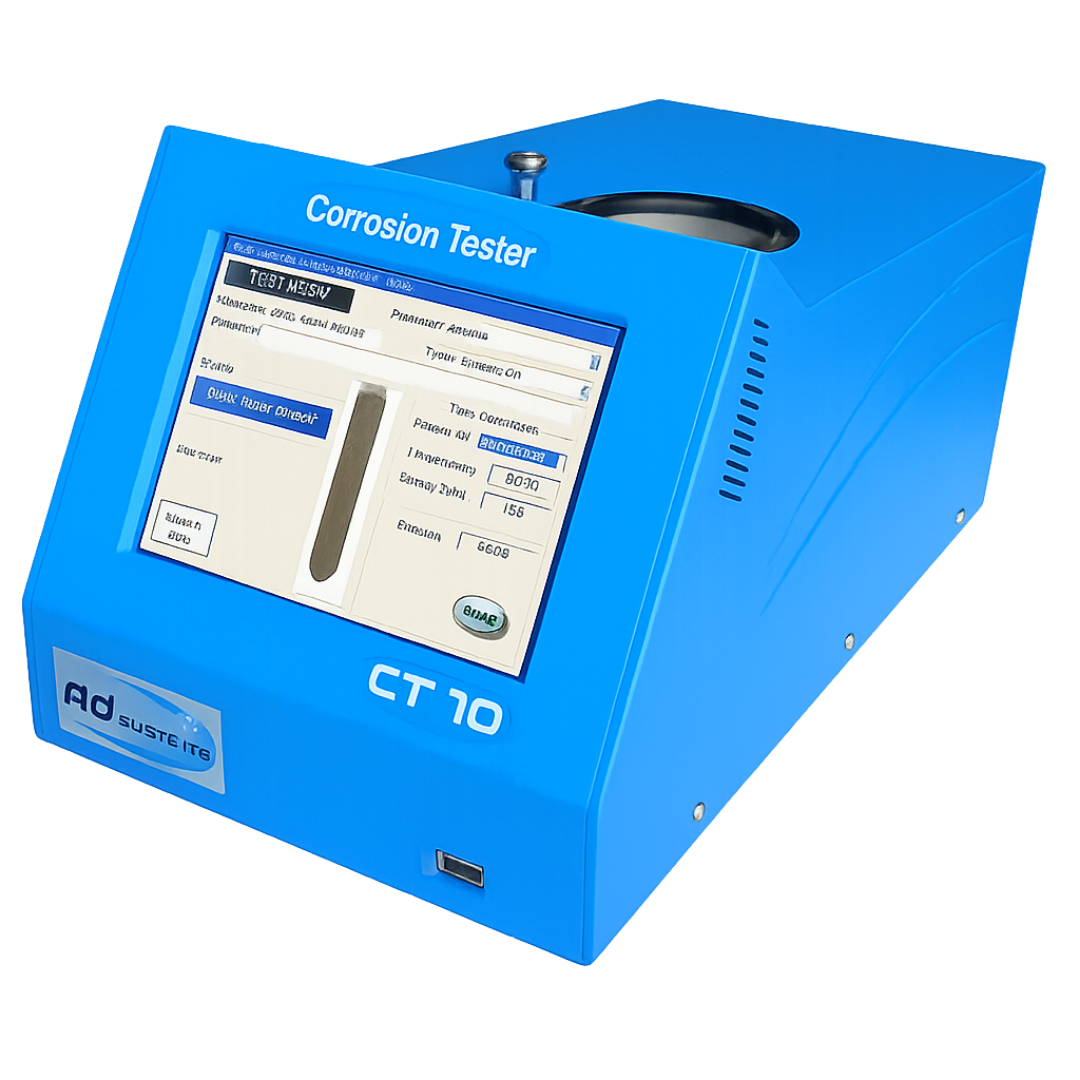
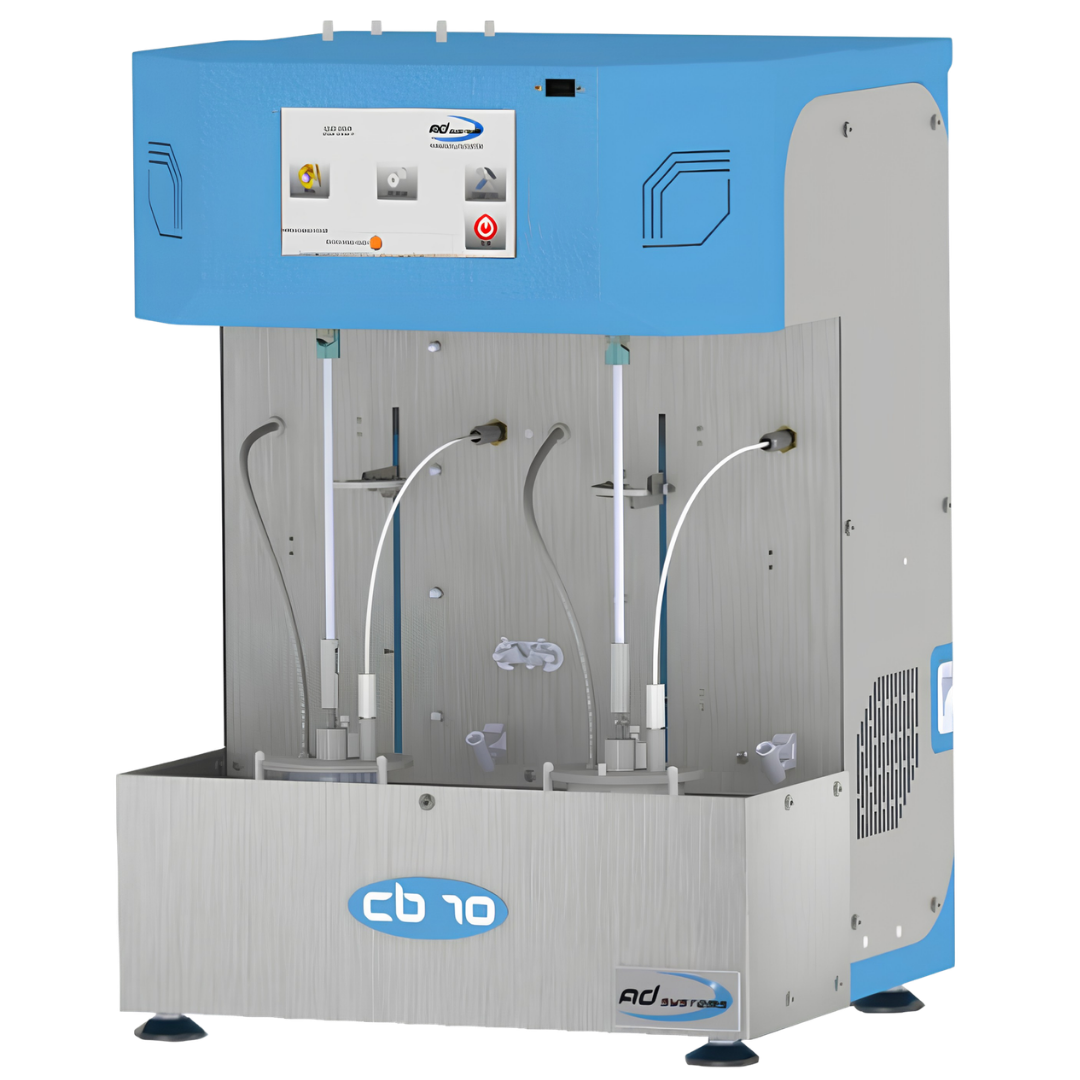
Corrosion Rating by Eye Has Always Been a Dispute Waiting to Happen
Corrosion testing per ASTM D665 and NACE TM0172 has always had the same weak point: the final rating. Whether an inhibited mineral oil passes or fails, whether a pipeline cargo is safe for transport — these decisions have historically come down to one operator looking at a corroded steel spindle and making a judgement call. Different operators. Different results. Disputes between suppliers and receivers that cost time, money, and credibility.
The AD Systems CB10 and CT10 solve this end to end. The CB10 is a fully automated corrosion bath — it runs ASTM D665 and NACE TM0172 tests on two specimens simultaneously with precise, programmable control of temperature, stirring speed, water injection, and test timing. No manual intervention from start to finish. When the test ends, the CB10 lifts the specimen automatically and presents it for rating.
The CT10 takes over from there. It images the entire corroded surface of the specimen using a CCD camera and homogeneous lighting, calculates the exact percentage of corroded area, and converts it automatically to the selected method’s rating — NACE TM0172 grades A through E, or D665 light/moderate/severe. A fully documented, traceable test report is ready in under five minutes. No subjectivity. No disputes.
What the CB10 & CT10 Deliver in Your Lab
Complete, Integrated Corrosion Testing System
The CB10 and CT10 are designed to work together as a single workflow. The CB10 runs the oxidation bath test. The CT10 reads and rates the specimen. Together they replace the entire manual corrosion testing process — preparation, timing, and rating — with a fully automated, fully documented system.
Two Independent Test Positions — Run Simultaneously
The CB10 runs two tests at the same time in fully independent positions. Specimen insertion, water injection, temperature, and timing are individually controlled per position. Labs that previously ran tests sequentially now double throughput with no additional operator time.
Fully Automated Bath Operation
Once the operator loads the sample and initiates the test, the CB10 handles everything: heating, stirring, water injection, test timing, and automatic specimen lift at end of test. The entire procedure runs unattended. Direct drive low-torque motors stop automatically if anything contacts the stirrer shaft — a built-in safety step that protects both operators and specimens.
Objective, Quantitative Corrosion Rating — CT10
The CT10 eliminates the subjectivity that has always undermined manual corrosion rating. A CCD camera and homogeneous lighting system image the entire specimen surface. Software calculates the exact percentage of corroded area to 0.01% resolution and converts it to the applicable rating scale. The same specimen, measured by any operator, on any day, produces the same result.
Automatic Specimen Diameter Verification — CT10
Before rating, the CT10 automatically measures the spindle diameter and verifies it falls within method tolerances. This step is often skipped in manual testing — the CT10 makes it automatic, protecting result validity and ensuring method conformance is documented in every report.
PT100 with Embedded Calibration Data — CB10
Both PT100 temperature sensors in the CB10 come with embedded calibration data. Temperature is controlled to ±1°C across the full programmable range up to 80°C. No external calibration reference is required — the calibration data lives in the instrument and travels with it.
ASTM Method Compliance
Standard Test Method for Rust-Preventing Characteristics of Inhibited Mineral Oil in the Presence of Water
Tests the ability of inhibited mineral oils to prevent corrosion of ferrous metals when water is present. Used for turbine oils, circulating oils, and compressor oils. The CB10 runs the oxidation bath per D665 procedure A and B; the CT10 rates the result as light, moderate, or severe.
Determination of Corrosiveness of Pipeline Cargoes in the Presence of Water
Used to determine the corrosiveness of petroleum products — gasolines and other distillates — before pipeline transportation. The CB10 controls the test conditions; the CT10 rates the spindle as A, B++, B+, B, C, D, or E. Proven CT10 correlation with NACE visual rating confirmed by comparative study.
Standard Test Method for Measurement of Corrosion Inhibition Using Accelerated Iron Corrosion in Petroleum Products
CT10 supported. Used for evaluating corrosion inhibitors in petroleum products, particularly for pipelines and tankers. The CT10's quantitative imaging replaces manual visual assessment for this method.
ALSO COMELATED / SUPPORTED
CB10 — Automated Corrosion Bath
Runs the test. The CB10 controls the entire corrosion bath procedure — specimen insertion, water injection, temperature, stirring, and timing — across two independent positions simultaneously. Delivers the conditioned specimen, ready for rating.
2 independent test positions — run simultaneously
Automatic specimen insertion and lift at test end
Automatic water injection — programmable up to 50 mL
Automatic water reserve monitoring — 1 L capacity
Temperature control: ambient to 80°C ±1°C (programmable)
Stirring: up to 2000 rpm ±50 rpm (programmable)
PT100 sensors with embedded calibration data
7″ full-color capacitive touch screen
Dry bath — no liquid bath medium required
Part No. AA231-001 — Delivered ready for operation
CT10 — Automated Steel Test Rod Corrosion Reader
Reads the result. The CT10 images the full surface of the corroded spindle, calculates corroded area to 0.01% resolution, and outputs a method-compliant rating in under five minutes. Replaces operator visual rating entirely.
CCD camera with homogeneous lighting — images entire specimen surface
Automatic corrosion percentage calculation: 0.00% to 100.00%
Automatic spindle diameter verification (resolution: 0.1 mm)
NACE TM0172 rating output: A, B++, B+, B, C, D, E
ASTM D665 rating output: Light, Moderate, Severe
Full-color image saved with every result
Detailed traceable test report in under 5 minutes
8″ full-color touch screen
1,600,000 pixel image resolution — 510 PPI
Results storage: database, USB, LAN — unlimited capacity
Part No. AA230-001 — Delivered ready for operation
Streamline Your Workflow from
Bath to Result
The CB10 and CT10 are designed as a complete system. The CB10 runs the bath test. The CT10 measures and rates the specimen. Together they cover the entire corrosion testing workflow — from sample preparation to documented result — with no manual judgement required at any step.
Specifications
Test methods
Provides ultra-precise specimen rating across the entire corrosion range, completely eliminating human subjectivity from your documented results.
Test methods
Rating scale
A, B++, B+, B, C, D, E (NACE) / Light, Moderate, Severe (D665)
Who Uses the CB10 & CT10
Petroleum Refinery & Lubricant QC Labs
Product release testing for turbine oils, circulating oils, compressor oils, and hydraulic fluids per ASTM D665. The CB10 runs the rust prevention test; the CT10 delivers an objective, documented rating that holds up to customer scrutiny and audit.
Fuel Pipeline & Terminal Operations
Corrosiveness testing of petroleum pipeline cargoes — gasolines, distillates — per NACE TM0172 before transportation. The CB10 and CT10 system produces NACE ratings that are defensible, reproducible, and eliminate disputes between shipper and receiver.
Lubricant & Additive Development Labs
Development and validation of corrosion inhibitor additive packages for mineral oils and petroleum products. The CT10's 0.01% resolution and fully quantitative output gives formulation chemists data that visual rating cannot provide.
Independent Testing Laboratories
Third-party corrosion testing services for refiners, lubricant manufacturers, and pipeline operators. The CB10 and CT10 system produces fully documented, traceable results that satisfy the most rigorous client and accreditation body requirements.
Industrial & Power Generation Facilities
On-site or in-house corrosion testing for turbine oils and circulating system fluids in power plants and industrial facilities — monitoring oil condition and verifying corrosion inhibitor performance before issues reach rotating equipment.
Government, Military & Research Labs
Standardised corrosion testing for military fuel and lubricant specifications, government fuel quality monitoring programs, and academic research into corrosion inhibition chemistry and petroleum product behaviour.
Why Get the CB10 & CT10 Through KB Scientific
Three things that set sourcing through KB Scientific apart from purchasing through a general lab distributor with no petroleum or lubricant testing background.
Advised by a Former Lab Manager
Kevin Batt has managed the type of petroleum and lubricant testing lab that runs ASTM D665 and NACE TM0172 daily. He understands the workflow, the frustration of disputed visual ratings, and exactly what the CB10 and CT10 replace. His recommendation comes from operational experience — not a product brochure.
Authorized AD Systems Representative
KB Scientific Instruments is an authorized representative for AD Systems in the Midwest, though US Partner DC Scientific — not a third-party reseller. Direct manufacturer relationship means accurate technical documentation, correct configuration guidance, and a clear line of accountability when you need support or spare parts.
Local Midwest Support
Based in Fishers, Indiana and serving 10 states. Kevin is reachable directly by phone or email for pre-sale guidance, setup questions, and post-delivery support — not a tiered support queue with multi-day response windows.
Frequently Asked
Questions
What lubricant lab managers, pipeline QC teams, and petroleum testing professionals ask most often about the AD Systems CB10 and CT10.
Do I need both the CB10 and CT10, or can I use them separately?
They can be used separately. The CB10 runs the corrosion bath test and outputs a conditioned specimen — you can then rate that specimen visually per the standard method if you choose. The CT10 can also rate specimens prepared in any ASTM D665 or NACE TM0172 compliant bath, not just the CB10. That said, the two instruments are designed to work together as a complete system, and the combination delivers the biggest improvement in speed, objectivity, and traceability. Kevin can advise on whether one or both instruments make sense for your specific workflow.
How does the CT10 compare to visual rating?
The CT10 was developed specifically because visual rating is subjective, operator-dependent, and a known source of disputes between product suppliers and receivers. The CT10 images the entire specimen surface, calculates corroded area to 0.01% resolution, and converts it to the method rating scale automatically. A comparative study confirmed strong correlation between CT10 results and NACE TM0172 visual rating — with the key difference that the CT10 result is the same regardless of which operator runs the test or when.
What corrosion methods do the CB10 and CT10 support?
The CB10 supports ASTM D665, D4378, NACE TM0172, IP135, ISO 7120, GOST 19199, and JIS K2510. The CT10 supports ASTM D665, D7548, NACE TM0172, IP 135, ISO 7120, and JIS K2510. Both instruments are delivered ready for operation per the selected standard — no additional configuration required.
Can the CB10 run two different test methods simultaneously?
Yes. Tests can be run unattended simultaneously or independently on the two positions.
How long does a complete test cycle take with the CB10 and CT10 together?
The CB10 test duration is set by the method — ASTM D665 requires a minimum of 24 hours. The CB10 runs this unattended. At the end of the test it automatically lifts the specimen for rating. The CT10 then measures and produces a fully rated, documented report in under five minutes. Total active operator time across the entire workflow: approximately 10 minutes.
What does the CT10 report include?
Every CT10 report includes: the full-colour image of the specimen surface, the binary image used for corrosion area calculation, the exact corrosion percentage, the method rating (NACE or D665), the specimen diameter (automatically measured and verified), test conditions (standard, temperature, duration), operator ID, sample ID, date and time, and software version. All reports are stored in the database and can be exported via USB or LAN.
Other Instruments You May Need
Ready to Eliminate Subjective Corrosion
Rating from Your Lab?
Request a Quote or Technical Consultation
Kevin Batt Will review your corrosion testing methods, current workflow, and throughput requirements, and advise whether the CB10, CT10, or both instruments fit your application. No sales script. No obligation.