
AD Systems TO10 & DR10 — Jet Fuel Thermal Oxidation Stability Testing System
ASTM D3241 · IP 323 · ISO 6249 compliant. Two instruments. One complete test. The TO10 runs the world’s most demanding jet fuel stability test — controlling fuel flow, bus bar temperature, and aeration with state-of-the-art precision. The DR10 measures the result — mapping the heater tube deposit in SI units as the ASTM D3241 Annex 2 referee instrument since 2014.
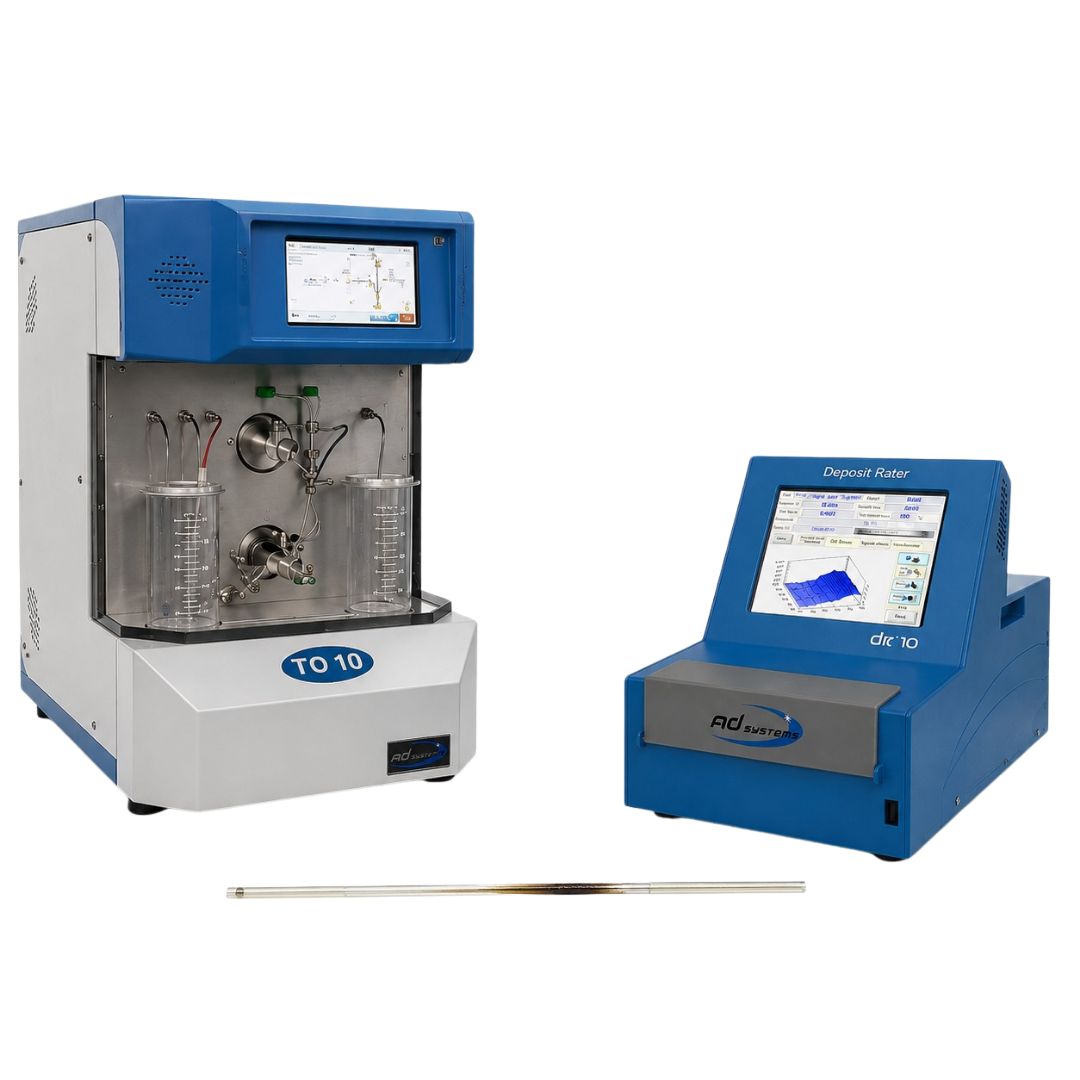
Jet Fuel Thermal Oxidation Stability Demands Both a Precision Test Rig and a Referee-Grade Measurement Instrument
ASTM D3241 is the most critical test in jet fuel quality — and it has two inseparable steps. First, the fuel is put through a full thermal oxidation stability test on a precision test rig: controlled fuel flow, controlled temperature profile, controlled aeration, for a controlled duration. Then the heater tube produced by that test is measured to determine whether the deposit formed meets specification. Get either step wrong and the result is worthless. The AD Systems TO10 handles the first step. The DR10 handles the second. Together they form the most complete, accurate, and reproducible ASTM D3241 system available.
The TO10 Thermal Oxidation Stability Test Rig was designed from the ground up to eliminate every source of test variation that undermines ASTM D3241 results in conventional rigs. Its dual 5 mL syringe fuel system delivers perfectly stable, pulse-free flow at ±1% accuracy — unlike the HPLC pumps in competing rigs that introduce flow variation and peak. Each bus bar has its own independent temperature control system using Peltier heat pipe technology, with no liquid cooling required. The test cell is fully enclosed with one-hand sliding safety doors and a fume extraction connection. Up to 21 test methods are stored on board, ready to run at a single selection. The TO10 connects directly to the DR10 via Ethernet for automatic result transfer at test completion.
For decades, the final step of ASTM D3241 was a visual rating — an operator comparing a corroded heater tube against a color standard and assigning a grade. In 2014, ASTM resolved this inherent subjectivity by adopting spectral reflectance interferometry as the referee method in D3241 Annex 2, requiring results to be reported in SI units. The AD Systems DR10 ITR Heater Tube Deposit Rater is the instrument that made this possible. It scans the full heater tube surface at 1,200 measurement points, reports average and maximum deposit thickness in nanometres and total deposit volume in cubic millimetres, produces a complete 3D map of the deposit distribution, and automatically flags any result exceeding the 85 nm threshold in red. No operator judgement. No inter-laboratory disputes. No subjectivity at any step.
What the TO10 & DR10 Deliver in Your Jet Fuel Lab
Unparalleled Fuel Flow Control — TO10 Dual Syringe
The TO10 uses a dual 5 mL syringe fuel pumping system with automatic priming. Unlike HPLC pumps used in competing test rigs, the dual syringe delivers perfectly stable flow with no pulse, no peak, and no flow variation. The fuel flow rate is programmable or set automatically per test method. Only 60 injection cycles are required for a full 150-minute test — minimal maintenance impact.
DR10 — The ASTM D3241 Referee Method Since 2014
The DR10 was declared the referee instrument in ASTM D3241 Annex 2, ASTM D1655, D7566, and DEF STAN 91-091. It is the only instrument that meets the ASTM requirement to report jet fuel thermal oxidation deposit in SI units. For any lab running D3241 to specification, the DR10 is not optional — it is the standard.
Independent Bus Bar Temperature Control — No Liquid Cooling
Each bus bar on the TO10 heater tube section has its own independent temperature control system. Bus bar cooling uses Peltier module heat pipe technology — no liquid cooling circulation, no associated maintenance or leak risk. The result is perfect, reproducible thermal profiles whatever the ambient laboratory conditions.
3D Deposit Mapping — Full Tube Surface in SI Units
The DR10 scans the entire surface of the ASTM D3241 heater tube at 1,200 measurement points using spectral reflectance interferometry. At the end of the scan it displays a full 3D map of the deposit distribution along and around the tube, reporting average thickness, maximum thickness, maximum thickness over the 2.5 mm² area defined in D3241, and total deposit volume. All results in nanometres and cubic millimetres.
Operator Safety — Enclosed Test Cell with Fume Extraction
The TO10 test cell is fully insulated with sliding safety doors that can be operated with one hand. A vapour extraction nozzle connects directly to a central fume extractor — no fuel vapour exposure to the operator. Beaker presence detectors prevent operation without correct setup. Safety is designed in, not added on.
Automatic Pass/Fail Warning — 85 nm Threshold
When the deposit thickness over the 2.5 mm² area exceeds the 85 nm limit specified in ASTM D1655, D7566, and DEF STAN 91-091, the DR10 displays the result in red. The laboratory technician receives an unambiguous visual warning without having to interpret a numerical result against a specification table.
ASTM Method Compliance
ASTM D3241 — Standard Test Method for Thermal Oxidation Stability of Aviation Turbine Fuels (JFTOT)
The TO10 runs the full D3241 thermal oxidation test — automating fuel flow, aeration, bus bar temperature, and test timing with up to 21 programmable method configurations. The DR10 measures the heater tube deposit per D3241 Annex 2 — the SI unit referee method adopted in 2014. Together they cover every step of ASTM D3241 from test initiation to certified SI unit result.
The international equivalents of ASTM D3241 for jet fuel thermal oxidation stability testing.
The TO10 supports IP 323 and ISO 6249 as native programmable test methods. Results from the DR10 are directly transferable across all three standards.
Jet fuel product specification standards that reference the 85 nm deposit threshold.
The DR10 compares measured results against this limit automatically and flags exceedances in red. These are the specifications that aviation fuel must meet before delivery — the DR10 provides the instrument evidence required.
TO10 — Thermal Oxidation Stability Test Rig
Runs the test. The TO10 controls every parameter that determines ASTM D3241 result accuracy — fuel flow, aeration, bus bar temperature profile, test timing, and safety. Connects directly to the DR10 for automatic result transfer via Ethernet.
State-of-the-art automation — all D3241 test parameters precisely controlled
Dual 5 mL syringe fuel system — stable flow, no pulse, no peak, accuracy ±1%
Automatic fuel aeration control with moisture content measurement and display
Independent bus bar temperature control — Peltier + heat pipe, no liquid cooling
Test temperature: programmable 100°C to 380°C
Differential pressure: 0–750 mmHg (automatically bypassed at +700 mmHg)
Test time range: programmable 4 to 600 minutes
Up to 21 programmable test methods
Insulated test cell with one-hand sliding safety doors
Vapour extraction nozzle connectable to central fume extractor
Beaker presence detectors — safety interlock
Diagnostic service menu with flow chart layout
DR10 connectivity via Ethernet RJ45 — full results transfer automatically
Dimensions: 440 x 600 x 670 mm (17″ x 23″ x 26″)
Weight: 75 kg (165 lbs)
Power: 100–240 V — 8A — 50/60 Hz
Operating temperature: +10°C to +35°C
DR10 — ITR Heater Tube Deposit Rater
Reads the deposit. The DR10 uses spectral reflectance interferometry to scan the full heater tube surface at 1,200 points, producing a 3D deposit map and SI unit results in 12 minutes. The referee instrument per ASTM D3241 Annex 2 since 2014.
Referee instrument — ASTM D3241 Annex 2, ASTM D1655, D7566, DEF STAN 91-091
Spectral reflectance interferometry — fiber optic probe + spectrometer
1,200 measurement points per tube scan (configurable)
Full scan: 12 minutes standard / 4 minutes fast mode
Reports: average thickness, maximum thickness, max thickness on 2.5 mm² area, deposit volume
Measurement range: 0–1200 nm thickness / 0–0.5 mm³ deposit volume
Resolution: deposit thickness calculated from interference fringe analysis
Automatic red flag when 85 nm threshold exceeded (ASTM D1655 / D7566 / DEF STAN 91-091)
Automatic result transmission to TO10 via Ethernet
Tube serial number entry simplified by onboard camera display
Reference tubes certified by national metrology laboratory (EN ISO/IEC 17025 traceable)
Results storage: limited only by external device capacity
Dimensions: 250 x 410 x 290 mm (10″ x 16″ x 12″)
Weight: 10 kg (22 lbs)
Power: 115–230 V — 2A — 50/60 Hz
One Test. Two Instruments.
No Subjectivity.
The TO10 and DR10 are designed to operate as one integrated system. The TO10 runs the full ASTM D3241 thermal oxidation stability test — controlling every variable that determines result accuracy. At test completion, results transfer automatically from the TO10 to the DR10 via Ethernet. The DR10 then scans the heater tube at 1,200 points and delivers a complete SI unit deposit result with 3D mapping in 12 minutes. No manual data transfer. No operator rating step. No subjectivity at any point in the workflow.
Specifications
Test methods
DR10 connectivity
full spectral reflectance scan — thickness, deposit volume, 3D map in SI units in one cycle
Test methods
Printer output
Who Uses the TO10 & DR10
Aviation Fuel Refineries & Producers
Product release testing for Jet A, Jet A-1, and JP-8 per ASTM D1655, D7566, and DEF STAN 91-091 requires ASTM D3241 thermal stability data with DR10 deposit measurement. The TO10 and DR10 together deliver the complete, specification-compliant result required before aviation fuel can be released.
Aviation Fuel Pipeline & Terminal Labs
Custody transfer compliance testing for aviation turbine fuels at pipeline terminals and fuel depots. The TO10 and DR10 system provides the SI unit deposit data required by ASTM D3241 Annex 2 — results that are defensible, reproducible, and eliminate rating disputes between fuel suppliers and receivers.
Independent Aviation Fuel Testing Laboratories
Third-party jet fuel testing services for fuel producers, airlines, and aviation authorities. The TO10 and DR10 system produces fully documented, traceable D3241 results that satisfy ISO 17025 accreditation requirements — with the DR10's national metrology laboratory-certified reference tubes providing the calibration traceability chain.
Fuel Additive & Thermal Stability Research
Development and validation of jet fuel thermal oxidation stability improver additives. The DR10's 3D deposit mapping and 0.01% resolution provide the quantitative, reproducible data that additive development programs require — data that visual rating methods cannot deliver.
Military Aviation Fuel Labs
Military jet fuel certification testing to DEF STAN 91-091 and MIL-SPEC requirements. The DR10 is the specified referee instrument in DEF STAN 91-091 — making it mandatory, not optional, for any lab running military aviation fuel certification.
Mobile & Field Laboratory Applications
The DR10's compact dimensions (250 x 410 x 290 mm, 10 kg) make it deployable in mobile laboratory configurations at airfields, pipeline terminals, and military forward operating locations where jet fuel quality must be verified before use.
Why Get the TO10 & DR10 Through KB Scientific
Three things that set sourcing through KB Scientific apart from a general lab distributor with no aviation fuel or petroleum testing background.
Advised by a Former Lab Manager
Kevin Batt has managed petroleum and fuel testing labs that run ASTM D3241 as part of their core test program. He understands the workflow, the previous limitations of visual tube rating, and what the TO10 and DR10 replace in a real lab environment. His guidance comes from experience, not a sales script.
Authorized AD Systems Representative
KB Scientific is an authorized representative for AD Systems in the Midwest. Direct manufacturer relationship means accurate technical documentation, correct system configuration guidance, and a clear line of accountability for post-installation support and spare parts.
Local Midwest Support
Based in Fishers, Indiana and serving 10 states. Kevin is reachable directly by phone or email — not a multi-day support queue. Pre-sale guidance, system integration questions (TO10 + DR10 connectivity), and post-delivery support are all handled directly and promptly.
Frequently Asked
Questions
What aviation fuel lab managers, jet fuel QC teams, and specification testing professionals ask most often about the AD Systems TO10 and DR10.
What is the ASTM D3241 test and what role do the TO10 and DR10 each play?
ASTM D3241 is the standard test method for thermal oxidation stability of aviation turbine fuels — one of the most critical tests in jet fuel quality programs. The test has two inseparable steps. First, a fuel sample is run through the JFTOT (Jet Fuel Thermal Oxidation Tester) procedure: controlled fuel flow, controlled bus bar temperature profile, controlled aeration, and controlled test duration. The TO10 Thermal Oxidation Stability Test Rig performs this step — automating every parameter that determines result accuracy. Second, the heater tube produced by that test is measured to quantify the deposit formed. Until 2014 this was done visually, with all the operator subjectivity that entails. In 2014, ASTM adopted spectral reflectance interferometry as the referee method in D3241 Annex 2, requiring SI unit reporting. The DR10 ITR Heater Tube Deposit Rater performs this step — scanning the full tube surface at 1,200 points and reporting average thickness, maximum thickness, deposit volume, and pass/fail status automatically. Neither instrument alone constitutes a complete ASTM D3241 test. Together they cover the entire workflow from test initiation to certified SI unit result.
Do I need both the TO10 and DR10, or can I use them separately?
The DR10 can measure heater tubes produced by any ASTM D3241-compliant test rig — not only the TO10. If your lab already runs D3241 on an existing rig, you can add the DR10 immediately as an upgrade to your measurement capability. The TO10 is the recommended test rig because it was designed specifically to maximise the accuracy of DR10 results — perfect fuel flow, perfect temperature profiles, and direct Ethernet connectivity for automatic result transfer. Together they form the most complete D3241 system available.
What does the DR10 actually measure and report?
The DR10 scans the full surface of the heater tube at 1,200 measurement points using spectral reflectance interferometry. It reports: average deposit thickness (0–1200 nm), maximum deposit thickness (0–1200 nm), maximum thickness over the 2.5 mm² area defined in ASTM D3241 (0–1200 nm), and total deposit volume (0–0.5 mm³). When the 2.5 mm² area measurement exceeds 85 nm — the pass/fail threshold in ASTM D1655, D7566, and DEF STAN 91-091 — the result is displayed in red automatically.
How long does a DR10 tube scan take?
A standard 1,200-point full tube scan completes in 12 minutes. The DR10 also offers a fast mode that completes the full scan in 4 minutes. The number of measurement points is configurable. A detailed report including the 3D deposit map, all thickness values, deposit volume, and pass/fail status is available immediately at scan completion.
How does the TO10 fuel flow system differ from conventional JFTOT rigs?
Most conventional JFTOT test rigs use HPLC-style pumps that produce flow variation, pulse, and peak — all of which affect the fuel condition in the heater tube section and therefore the deposit result. The TO10 uses a dual 5 mL syringe system with automatic priming that delivers perfectly stable, pulse-free fuel flow at the programmed rate. Only 60 injection cycles are required for a full 150-minute test, minimising maintenance requirements significantly.
What reference materials are available to verify DR10 accuracy?
AD Systems produces thin-film thickness reference tubes for DR10 accuracy verification. The thickness of each thin-film tag on these reference tubes is certified by a national metrology laboratory and meets the EN ISO/IEC 17025 requirements for calibration and testing laboratories. This provides the full calibration traceability chain required for accredited laboratory operation.
Other Instruments You May Need
Ready to Run ASTM D3241 the Right Way —
Complete Test Rig and Referee-Grade Measurement in One System?
Request a Quote or Technical Consultation
Tell Kevin your current D3241 setup — whether you run an existing JFTOT rig and need the DR10 measurement upgrade, or whether you are building a complete TO10 + DR10 system from the ground up. He will configure the right solution and walk you through the integration. Response within one business day.